
Thermal Air Stratification: Why 9-Metre Ceiling Detectors Failed at the Saltley Shredder Bay Fire
On Friday 30 October 2026, an unmanifested lithium battery entered thermal runaway deep inside a commercial shredder bay on Adderley Road South, Saltley, Birmingham. Despite statutory compliance on paper, ceiling aspirating sampling pipes nine metres above the pile remained starved of combustion gases for 28 minutes until catastrophic flashover. This report deconstructs the physical breakdown of ceiling detection in high-hazard recycling sheds—and proves how optical computer vision at the fuel surface intercepts incipient smoulder in 4.2 seconds.
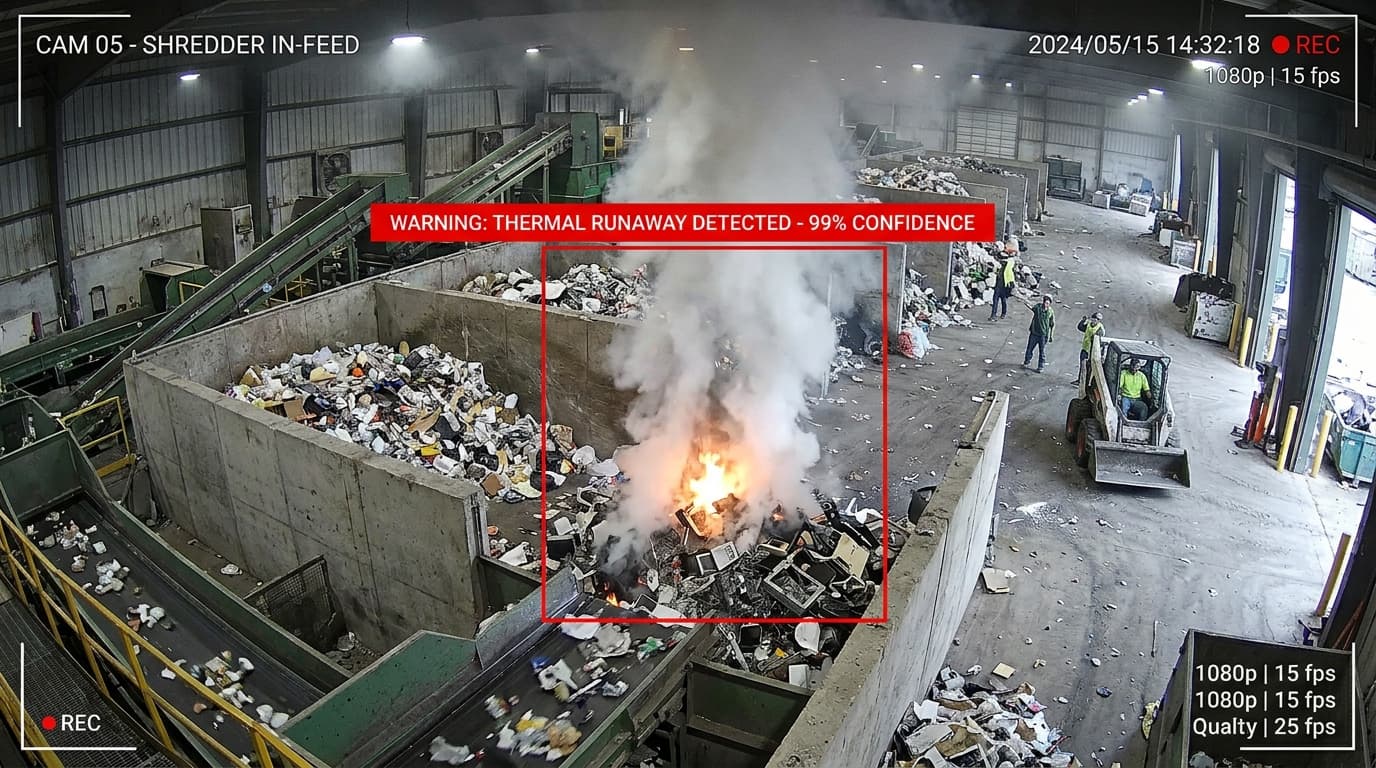
SURFACE OFF-GAS DETECTED: +4.2s
CEILING PIPE LEVEL: 0.00 dB/m (BLIND)
The Illusion of Compliance: Why Approved Systems Burn Down Facilities
The Saltley site possessed an approved Environment Agency Fire Prevention Plan (FPP). It possessed ceiling-mounted Aspirating Smoke Detection (ASD) pipes complying with BS 5839-1. It passed local fire authority audits.
Yet, on Friday night, the entire 800-tonne shredder bay was reduced to twisted structural steel. The fire brigade was dispatched not by automated site telemetry, but by a 999 call from a civilian driver on the nearby railway bypass who witnessed 15-metre external flames punching through the corrugated roof.
Minute-by-Minute Incident Reconstruction: Adderley Road South
Forensic chronometer calibrated from site CCTV recovery & telemetry logs
High-Torque Shredder Ingestion & Lithium Puncture
An unmanifested 48V e-bike lithium battery concealed in mixed automotive scrap enters the primary slow-speed shredder. Shear teeth puncture multiple pouch cells, creating immediate internal dead shorts.
Dense, Heavy Electrolyte Aerosol Eruption
Thermal runaway initiates in adjacent cells. A dense, grey-white electrolyte vapor plume (hydrofluoric acid, ethyl methyl carbonate, carbon monoxide aerosol) erupts from the discharge conveyor bed at 140°C.
Plume Stalls at 4.5 Metres Below Cold-Air Cushion
As the smoke plume rises, entrainment of cool ambient air (8°C ambient shed temperature) rapidly cools the gases. At 4.5 metres, plume temperature reaches thermal equilibrium with the surrounding air. The smoke loses all buoyant lift and forms a flat, stagnant stratiform cloud.
Open 6.2m Yard Shutter Disperses Aerosol Horizontally
Autumn night breeze (1.8 m/s) entering through the open plant intake roller shutter sweeps the stratified smoke cloud laterally across the yard floor, diluting particulate concentration to 0.02 dB/m.
Auto Shredder Residue (ASR) Bed Ignites Internally
The smouldering pocket reaches 650°C inside the flock pile. Volatile pyrolysis hydrocarbons accumulate beneath the pile crust.
Crust Rupture & 15-Metre Hydrocarbon Fireball
The pile surface ruptures as hydrocarbons achieve auto-ignition temperature. An instant 1,000°C fireball erupts, punching through the corrugated steel roof.
Ceiling Aspirating Alarm Finally Tripped (28 Minutes Too Late)
Only when 850°C thermal radiation burns through the aspirating sampling pipe does the central alarm panel trigger. Structural roof collapse begins 4 minutes later. 17 fire appliances and over 100 West Midlands Fire Service personnel respond to contain external spread.
Request a 14-Day Optical AI Stream Pilot on Your Shredder or Battery Bay
Don’t wait for an unmanifested vape or battery pack to expose ceiling detector blind spots. Connect FireVision to your existing RTSP cameras overlooking shredder intake hoppers, discharge conveyors, and quarantine bays.
Book an EA FPP Stratification Audit
Evaluate whether your high-hazard shed suffers from ceiling smoke transit blind spots.